Prisma Trade-Ups
Market intelligence for the CS2 economy.
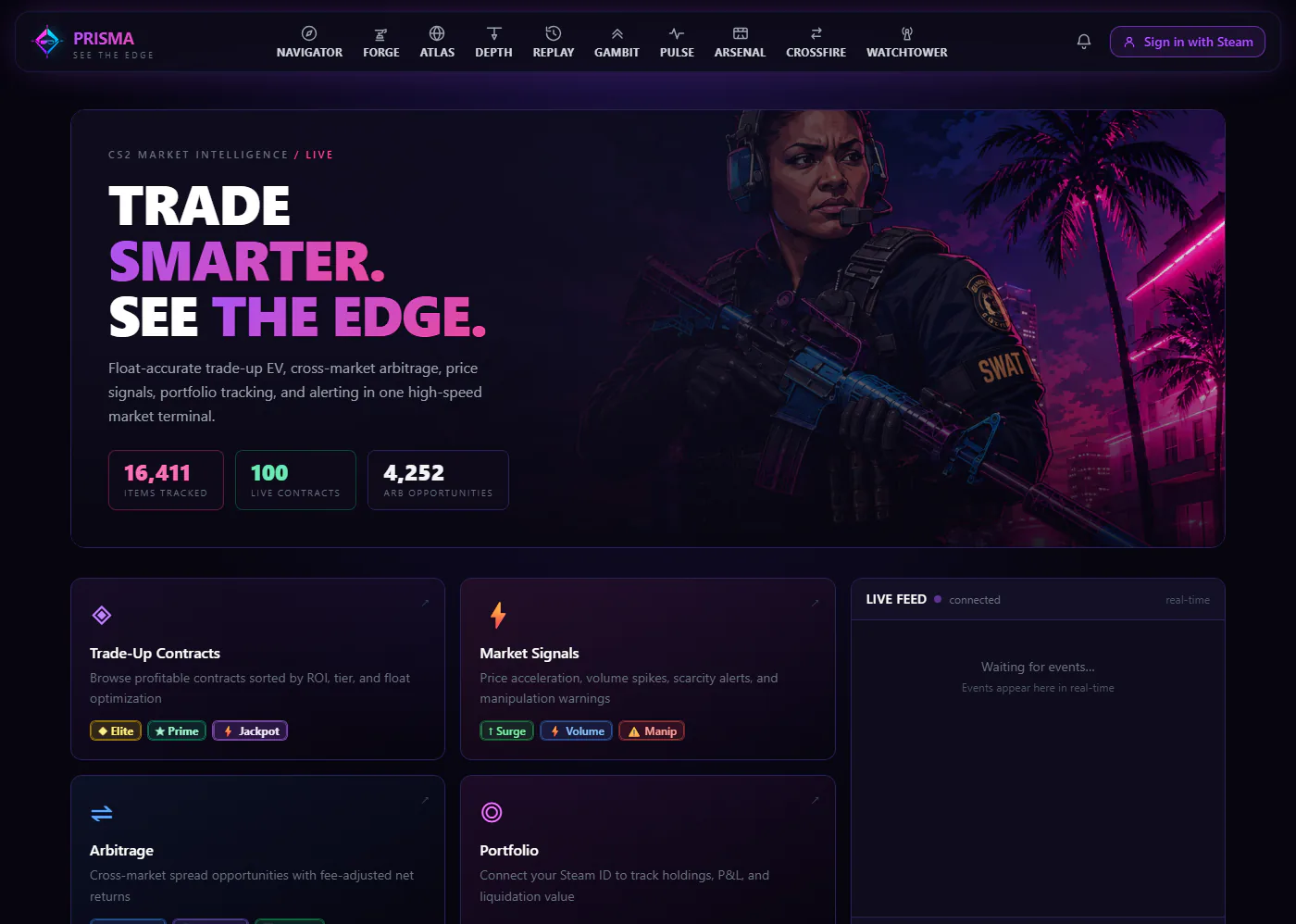
A platform for float-aware trade-up analysis, cross-market opportunities, price and scarcity signals, portfolio tracking, and accountable historical replay.
- Status
- LIVE
- Source
- Private
- Capabilities
The problem
The CS2 item economy is spread across several marketplaces that price the same item differently. Trade-up contracts, cross-market spreads, and scarcity only become sound decisions when the prices underneath them can be trusted.
Prisma Trade-Ups brings those prices together and turns them into ranked, explainable opportunities, so traders state their constraints instead of searching each market and section by hand.
The system
Navigator
Ranked trade-up and cross-market routes filtered by a trader’s constraints, each with a score and a separate confidence figure.
Forge
Builds trade-up contracts from constraints, with alternatives and a breakdown of each outcome’s probability-weighted value. Float is currently estimated from wear bands.
Market signals
Pulse, Atlas, and Depth cover price movement, volume, scarcity, how the economy connects, and liquidity and exit options by venue.
Arsenal
Portfolio tracking with Steam sign-in. Anyone can preview an inventory, while stored holdings stay private to their owner.
Replay
Scores past signals only after their window closes, using the prices available at the time, and reports insufficient data instead of an early number.
How it was built
A Next.js and TypeScript frontend reads from a FastAPI service. Scheduled Celery workers collect marketplace prices into PostgreSQL with TimescaleDB for price history, and separate engines compute trade-ups, cross-market spreads, and market signals into tables the API serves.
Redis backs the task queue, response caching, and sessions. Replay reads from append-only history tables that capture jobs extend over time.
Collect
- Scheduled Celery workers
- Marketplace price collectors
Store
- PostgreSQL + TimescaleDB history
- Latest-price tables
- Replay history
Analyze
- Trade-up engine
- Cross-market spreads
- Market signals
Serve
- FastAPI and live feed
- Redis cache and sessions
Interface
- Next.js App Router
- React + TypeScript
Technology
Design decisions
One source of truth for every figure
Navigator and Forge filter and score what the scheduled engines already computed. They never recalculate value or spreads, so one opportunity cannot show different numbers on different pages.
Verified or hidden
A price is shown only when it is corroborated across sources or cross-checked. Otherwise the interface says the price is unavailable, because no number is better than a wrong one.
No look-ahead in Replay
Outcomes are judged only after their window closes, using prices up to that cutoff, and a result needs a minimum sample before any figure appears.
Measured and modelled stay separate
Without completed-sale data, time-to-sale is labelled as a modelled estimate, and low confidence hides the estimate instead of widening it.
Selected views
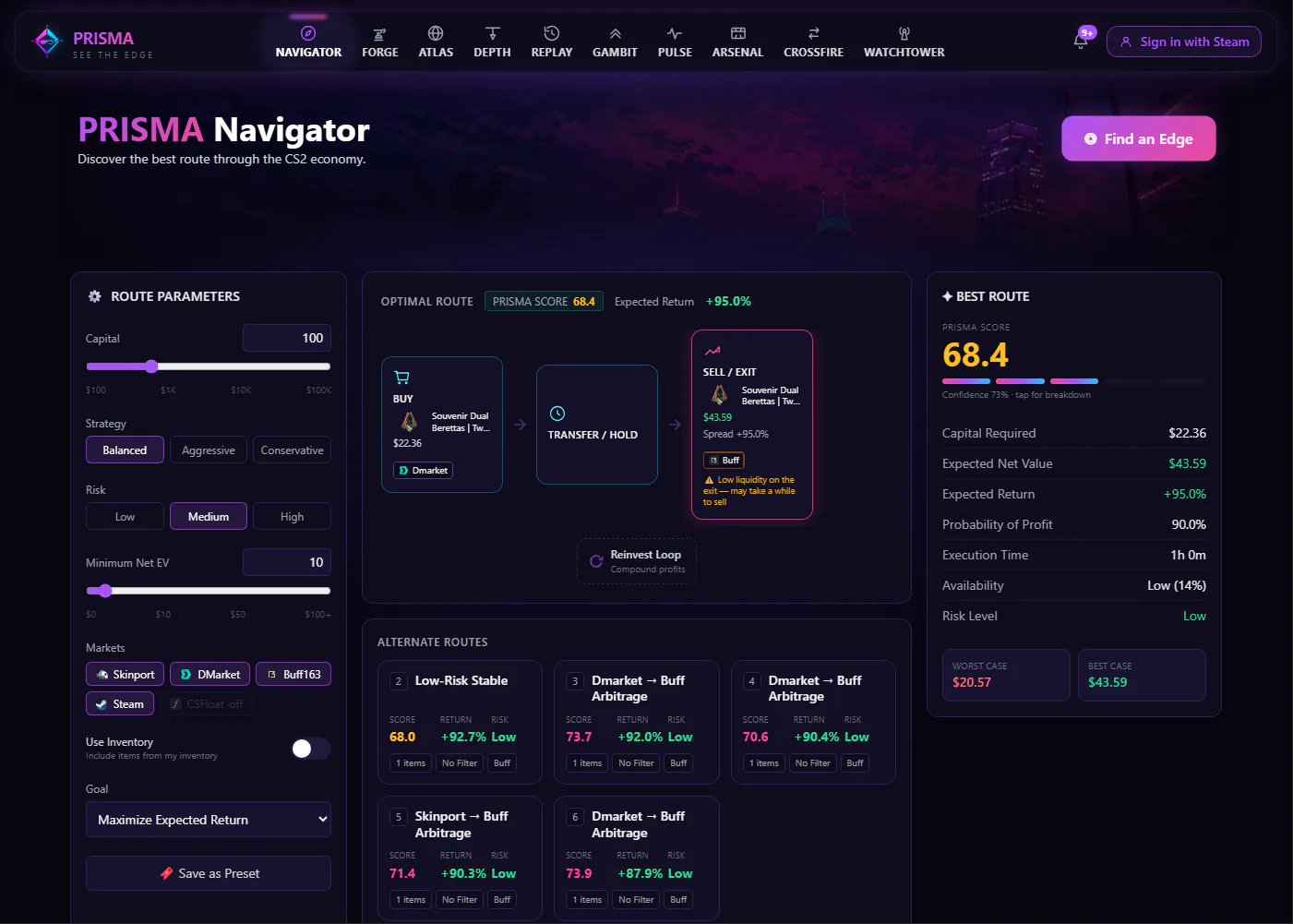
NavigatorRanked routes filtered by constraints, each with a score and a confidence figure. Live market data as of September 14, 2026. 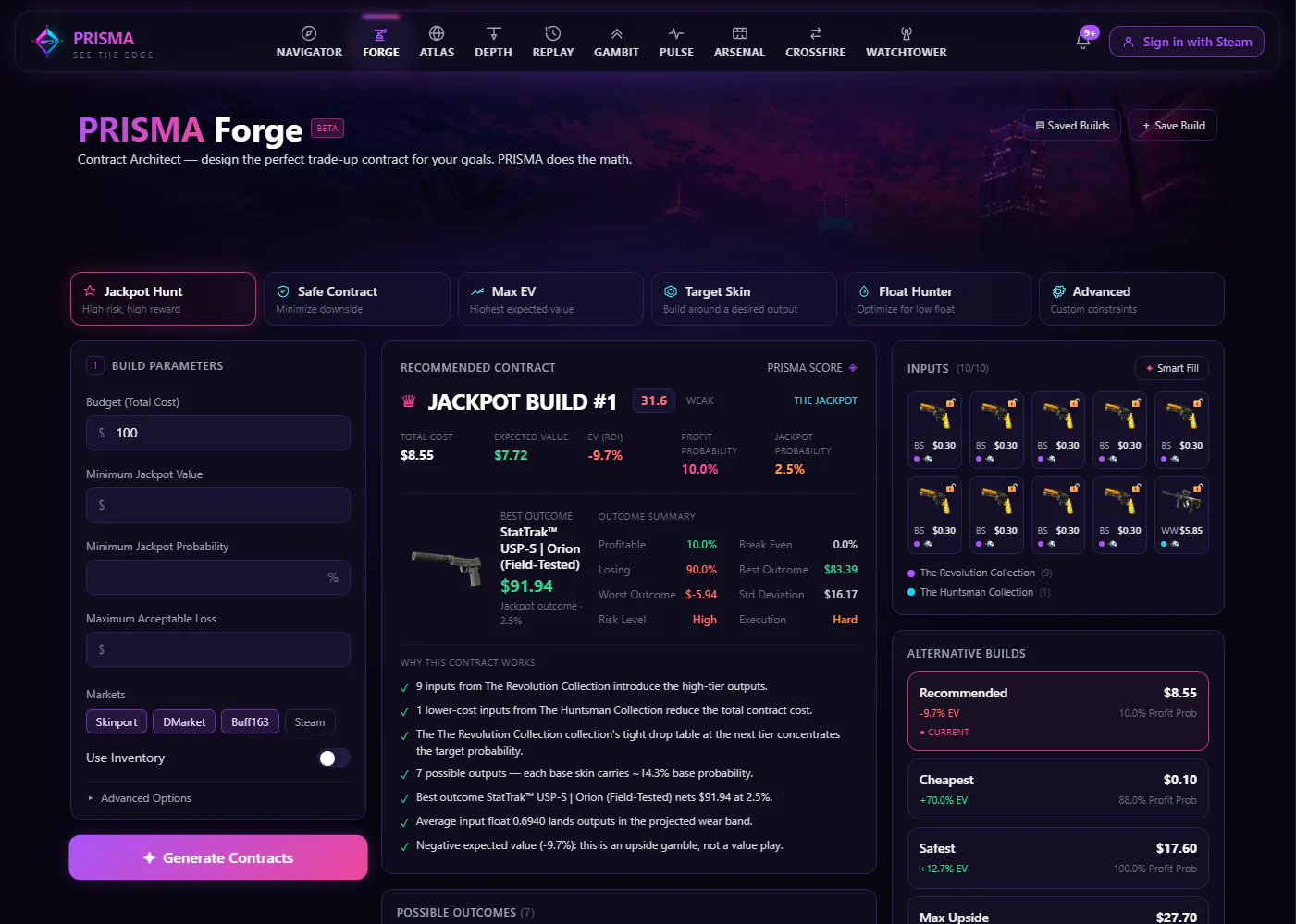
ForgeBuilding a trade-up contract from constraints, with alternatives and an outcome breakdown. Live market data as of September 14, 2026. 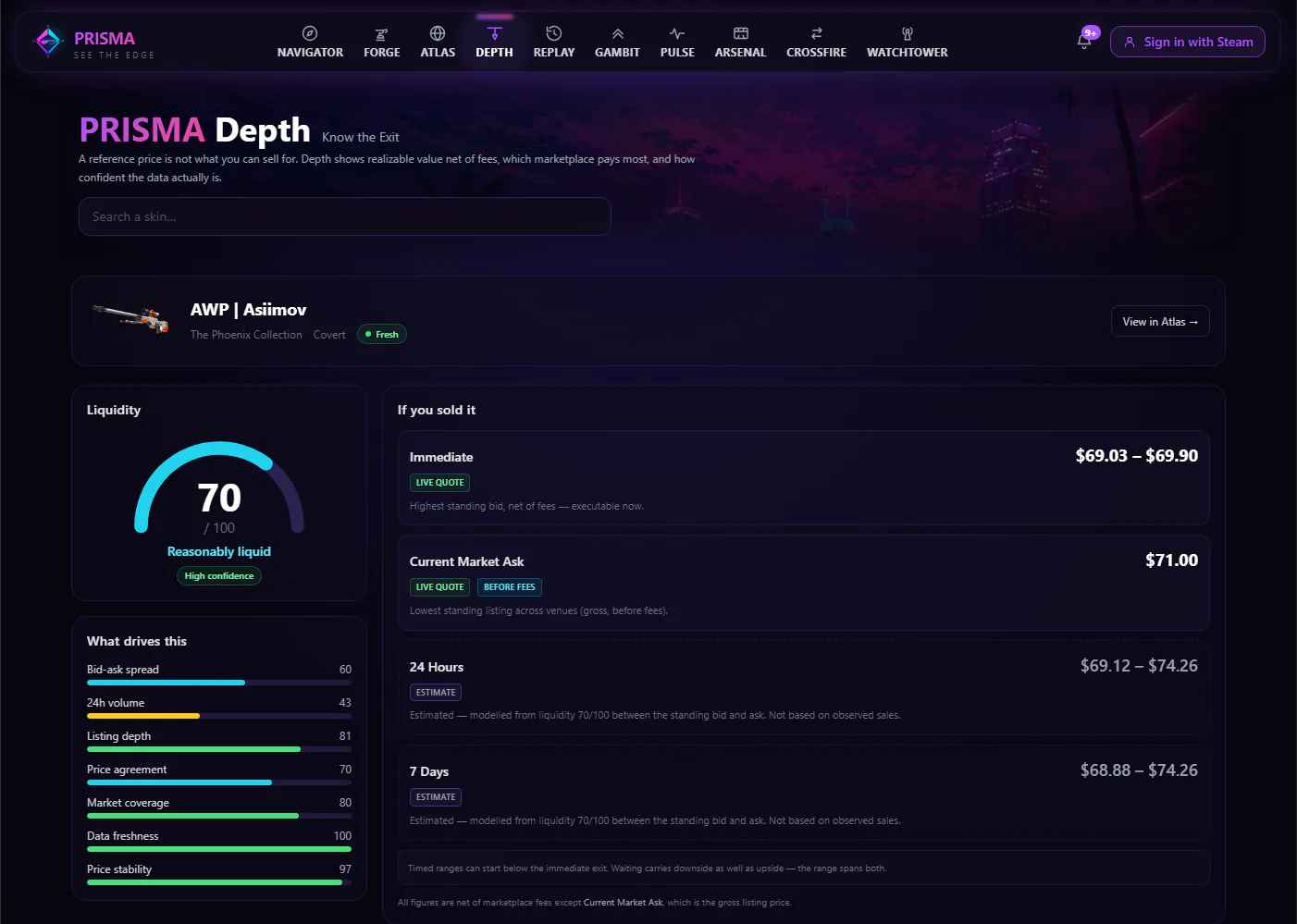
DepthWhat an item would realize if sold now or later, net of fees, with modelled ranges labelled as estimates. Live market data as of September 14, 2026. 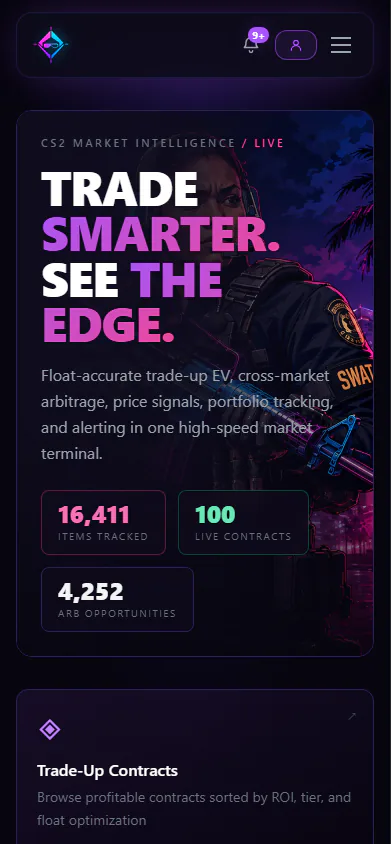
On a phoneThe signed-out home page at a 390px viewport.
Current state
Live. Navigator, Forge, Atlas, Depth, and Replay are shipped. Replay’s history is still young, so its track record is intentionally sparse. The source code is private.